Hospital Bed Capacity: Rural Areas vs Urban Areas — Why the Gap Matters and How to Close It
Hospital Bed Capacity: Rural Areas vs Urban Areas — Why the Gap Matters and How to Close It
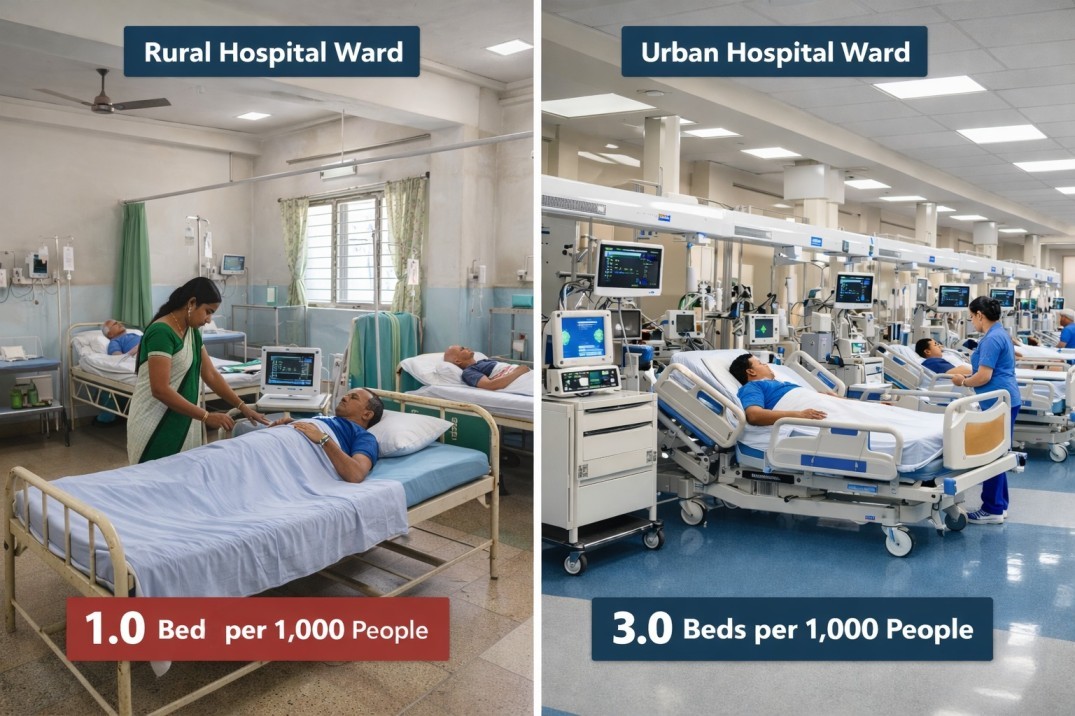
Hospital bed capacity in India has long been a subject of public discussion, especially because of the clear imbalance between rural and urban healthcare infrastructure. While India’s healthcare system has expanded significantly over the past decade, the distribution of resources remains uneven.
Nearly two-thirds of India’s population lives in rural areas, yet healthcare infrastructure and hospital bed availability are concentrated largely in urban centres. Investment in metropolitan and tier-1 cities far exceeds that of rural districts, leading to disparities in accessibility and quality of care.
The difference is not just in the number of beds but also in the type of facilities available. Urban hospitals are often equipped with advanced ICUs, specialist departments, modern operation theatres, and high-end diagnostic systems. In contrast, many rural hospitals and community health centres operate with limited inpatient beds, basic equipment, and shortages of trained medical personnel.
Healthcare in India is becoming more technologically advanced every year. However, rising costs and uneven infrastructure development mean that access to quality care is still strongly influenced by geography.
The Numbers Behind the Gap
India’s hospital bed density is estimated at approximately 1 to 1.5 beds per 1,000 population (including both public and private sectors). This is significantly lower than the global average, which is close to 3 beds per 1,000 population.
However, the national average hides a deeper issue — geographic concentration.
Urban areas have a substantially higher bed density.
Rural regions often fall below the national average.
Critical care beds, ventilators, and specialist services are disproportionately located in cities.
Public sector bed availability in rural areas is especially limited.
This uneven distribution creates structural pressure on urban hospitals while leaving rural populations underserved.
Why the Gap Matters
-
Delayed Access to Care
Patients in rural regions frequently travel long distances to reach tertiary care facilities. In emergencies such as trauma, cardiac events, obstetric complications, or severe infections, time lost in transit can significantly affect outcomes.
-
Financial Strain on Households
Seeking treatment in urban private hospitals increases costs related to travel, accommodation, and lost income. Out-of-pocket health expenditure remains a major concern in India.
-
Overburdened Urban Healthcare Systems
Because rural facilities often lack advanced services, patients are referred to cities even for treatable conditions. This contributes to overcrowding in urban hospitals.
-
Healthcare Inequity
Access to timely and quality inpatient care should not depend on where a person lives. Yet the rural–urban divide continues to influence health outcomes across the country.
The Way Forward
Addressing the rural–urban hospital bed gap requires targeted infrastructure expansion, workforce redistribution, improved referral systems, digital health integration, and sustainable public–private collaboration.
Strengthening district hospitals, upgrading community health centres, expanding critical care capacity in rural regions, and improving affordability are essential steps toward a more balanced healthcare system.
India’s healthcare system is large and complex, but bridging the bed capacity gap is central to improving equity, resilience, and long-term national health outcomes.
How KRAFT Is Contributing
As a brand of Solokrafts Industries, KRAFT is contributing to bridging the rural–urban healthcare gap by delivering durable, cost-effective, and clinically efficient hospital beds designed for diverse care environments. By focusing on intelligent design, patient comfort, and long-term reliability, KRAFT supports district hospitals, community health centres, and emerging healthcare facilities in upgrading their inpatient infrastructure without excessive financial burden. The emphasis on robust construction, ease of maintenance, and essential ICU functionalities ensures that even resource-limited settings can provide safer and more comfortable patient care. Through consistent quality standards and dependable after-sales support, KRAFT aims to strengthen grassroots healthcare capacity and help bring modern hospital infrastructure closer to rural communities.

Fowler Bed with Mattress: A Complete Buying Guide for Hospitals and Home Care
Hospital Bed Capacity: Rural Areas vs Urban Areas — Why the Gap Matters and How to Close ...

General
Why do hospital beds have side rails and why are hospital bed side rails removable?
Hospital Bed Capacity: Rural Areas vs Urban Areas — Why the Gap Matters and How to Close ...

General
What makes Single function Semi-automatic Motorized bed stand out in the Market?
Hospital Bed Capacity: Rural Areas vs Urban Areas — Why the Gap Matters and How to Close ...

General
Hospital Beds with Wheels — Why Castors Matter More Than You Think
Hospital Bed Capacity: Rural Areas vs Urban Areas — Why the Gap Matters and How to Close ...

General
Hospital Furniture Color Selection: Why is it Important?
Hospital Bed Capacity: Rural Areas vs Urban Areas — Why the Gap Matters and How to Close ...

General
Manual Hospital Beds in India: Why They Still Dominate Healthcare
Hospital Bed Capacity: Rural Areas vs Urban Areas — Why the Gap Matters and How to Close ...

General
The Importance of Ergonomic Hospital Bed Design
Hospital Bed Capacity: Rural Areas vs Urban Areas — Why the Gap Matters and How to Close ...

General
How to Increase Customer Experience in the Healthcare Sector with KRAFT Solutions
Hospital Bed Capacity: Rural Areas vs Urban Areas — Why the Gap Matters and How to Close ...

General
How to Assemble, Set Up, and Maintain Hospital Beds
Hospital Bed Capacity: Rural Areas vs Urban Areas — Why the Gap Matters and How to Close ...

General
Why Is It Important to Meet Us at Medicall Expo Every Year ?
Hospital Bed Capacity: Rural Areas vs Urban Areas — Why the Gap Matters and How to Close ...

General
FAQ for Hospital Bed
Hospital Bed Capacity: Rural Areas vs Urban Areas — Why the Gap Matters and How to Close ...

General
What to Do When a Motorized Hospital Bed Stops Working: A Step-by-Step Guide
Hospital Bed Capacity: Rural Areas vs Urban Areas — Why the Gap Matters and How to Close ...

General
What Else Should You Order Apart from a Hospital Bed for a Homecare Patient?
Hospital Bed Capacity: Rural Areas vs Urban Areas — Why the Gap Matters and How to Close ...

2 Function Hospital bed – A detailed preview
Hospital Bed Capacity: Rural Areas vs Urban Areas — Why the Gap Matters and How to Close ...

KRAFT 144 – The Ideal Single-Function Hospital Bed for Ward & Home Care
Hospital Bed Capacity: Rural Areas vs Urban Areas — Why the Gap Matters and How to Close ...

General, General
India Hospital Furniture Market Overview
Hospital Bed Capacity: Rural Areas vs Urban Areas — Why the Gap Matters and How to Close ...

General
Complete Guide to Choosing the Right Hospital Furniture for Your Healthcare Facility
Hospital Bed Capacity: Rural Areas vs Urban Areas — Why the Gap Matters and How to Close ...

General
Recliner Bed for Patient Care at Home
Hospital Bed Capacity: Rural Areas vs Urban Areas — Why the Gap Matters and How to Close ...

The History of Hospitals: From Ancient Healing Places to Modern Medical Institutions
Hospital Bed Capacity: Rural Areas vs Urban Areas — Why the Gap Matters and How to Close ...

General
Common Issues in Hospital Beds and How to Fix Them
Hospital Bed Capacity: Rural Areas vs Urban Areas — Why the Gap Matters and How to Close ...

General
Hospital Food Table / Tray / Trolley for Patients
Hospital Bed Capacity: Rural Areas vs Urban Areas — Why the Gap Matters and How to Close ...

General
Rent or Buy a Hospital Bed – Which is Better?
Hospital Bed Capacity: Rural Areas vs Urban Areas — Why the Gap Matters and How to Close ...

General
Adjustable Medical Beds for Elderly and Bedridden Patients at Home
Hospital Bed Capacity: Rural Areas vs Urban Areas — Why the Gap Matters and How to Close ...

General
Hospital Bed Mattresses in Chennai – A Buyer’s Guide by KRAFT Supplier, Tamil Nadu
Hospital Bed Capacity: Rural Areas vs Urban Areas — Why the Gap Matters and How to Close ...

General
Advantages of Hospital Beds in Home
Hospital Bed Capacity: Rural Areas vs Urban Areas — Why the Gap Matters and How to Close ...

General
Hospital Bed Price in India: A Complete Guide
Hospital Bed Capacity: Rural Areas vs Urban Areas — Why the Gap Matters and How to Close ...

General
Why ‘Where Can I Buy a Hospital Bed Near Me?’ Is No Longer Important
Hospital Bed Capacity: Rural Areas vs Urban Areas — Why the Gap Matters and How to Close ...

General
CSR in Action: 1 Bed for 1000 People – Bridging India’s Critical Healthcare Infrastructure Gap
Hospital Bed Capacity: Rural Areas vs Urban Areas — Why the Gap Matters and How to Close ...

General
Discover the Benefits of Vertical and Horizontal Autoclave Hospital Machines with Us – Trusted Manufacturers in Chennai
Hospital Bed Capacity: Rural Areas vs Urban Areas — Why the Gap Matters and How to Close ...

General
Revolutionizing Patient Recovery: ICU Beds with Built-in Weighing Scales
Hospital Bed Capacity: Rural Areas vs Urban Areas — Why the Gap Matters and How to Close ...

General
Artificial Intelligence in Medicine: The Future of Healthcare is Here
Hospital Bed Capacity: Rural Areas vs Urban Areas — Why the Gap Matters and How to Close ...

General
The Vital Importance of Emergency Crash Carts in Hospitals
Hospital Bed Capacity: Rural Areas vs Urban Areas — Why the Gap Matters and How to Close ...

General
How to Prevent Bed Sores in Bedridden Patients- Methods & Care Product
Hospital Bed Capacity: Rural Areas vs Urban Areas — Why the Gap Matters and How to Close ...

General
GBS Outbreak in Recent News: What You Need to Know
Hospital Bed Capacity: Rural Areas vs Urban Areas — Why the Gap Matters and How to Close ...

General
The health benefits of chocolate
Hospital Bed Capacity: Rural Areas vs Urban Areas — Why the Gap Matters and How to Close ...

General
How to stay safe and also free from anxiety in times of Corona Virus
Hospital Bed Capacity: Rural Areas vs Urban Areas — Why the Gap Matters and How to Close ...

Weight gain during pregnancy - What to expect when you’re expecting
Hospital Bed Capacity: Rural Areas vs Urban Areas — Why the Gap Matters and How to Close ...

General
What Is Antenatal Yoga? How Can You Pick A Good Antenatal Class?
Hospital Bed Capacity: Rural Areas vs Urban Areas — Why the Gap Matters and How to Close ...

India - A Fast Growing Medical Touring Hub
Hospital Bed Capacity: Rural Areas vs Urban Areas — Why the Gap Matters and How to Close ...

General
Getting pregnant with a low sperm count - it is possible!
Hospital Bed Capacity: Rural Areas vs Urban Areas — Why the Gap Matters and How to Close ...

General
3 Incredible Ways Virtual Reality Is Changing The Medical Industry
Hospital Bed Capacity: Rural Areas vs Urban Areas — Why the Gap Matters and How to Close ...

General
Getting Pregnant with Irregular Cycles - Is it Possible?
Hospital Bed Capacity: Rural Areas vs Urban Areas — Why the Gap Matters and How to Close ...

General
The Rise of Wearable Tracking Devices
Hospital Bed Capacity: Rural Areas vs Urban Areas — Why the Gap Matters and How to Close ...

General
The Health Risks of Late Pregnancies
Hospital Bed Capacity: Rural Areas vs Urban Areas — Why the Gap Matters and How to Close ...

General
Telehealth - A Stepping Stone to a Better Future
Hospital Bed Capacity: Rural Areas vs Urban Areas — Why the Gap Matters and How to Close ...

General
Technology Advancements are Transforming the Entire Healthcare Industry
Hospital Bed Capacity: Rural Areas vs Urban Areas — Why the Gap Matters and How to Close ...

General
Skip Dinner. Lose Weight.
Hospital Bed Capacity: Rural Areas vs Urban Areas — Why the Gap Matters and How to Close ...

General
Optogenetics- Understanding the Human Brain
Hospital Bed Capacity: Rural Areas vs Urban Areas — Why the Gap Matters and How to Close ...

General
Online Information through EHR and EMR
Hospital Bed Capacity: Rural Areas vs Urban Areas — Why the Gap Matters and How to Close ...

General
Mobile Health App Adoption
Hospital Bed Capacity: Rural Areas vs Urban Areas — Why the Gap Matters and How to Close ...